Growing Sweet Potato Slips in a Jar (and Why I Let Mine Go Completely Wild 🥔🔥🌿)
🗒️Rooted Field Note: 34
🌿 What Are Sweet Potato Slips?
Sweet potato slips are vine cuttings that grow from a sweet potato and can be rooted and planted to grow new plants.
Instead of planting seeds, growing sweet potato slips means taking these shoots, rooting them in water, and then planting them in warm soil once they’re established.
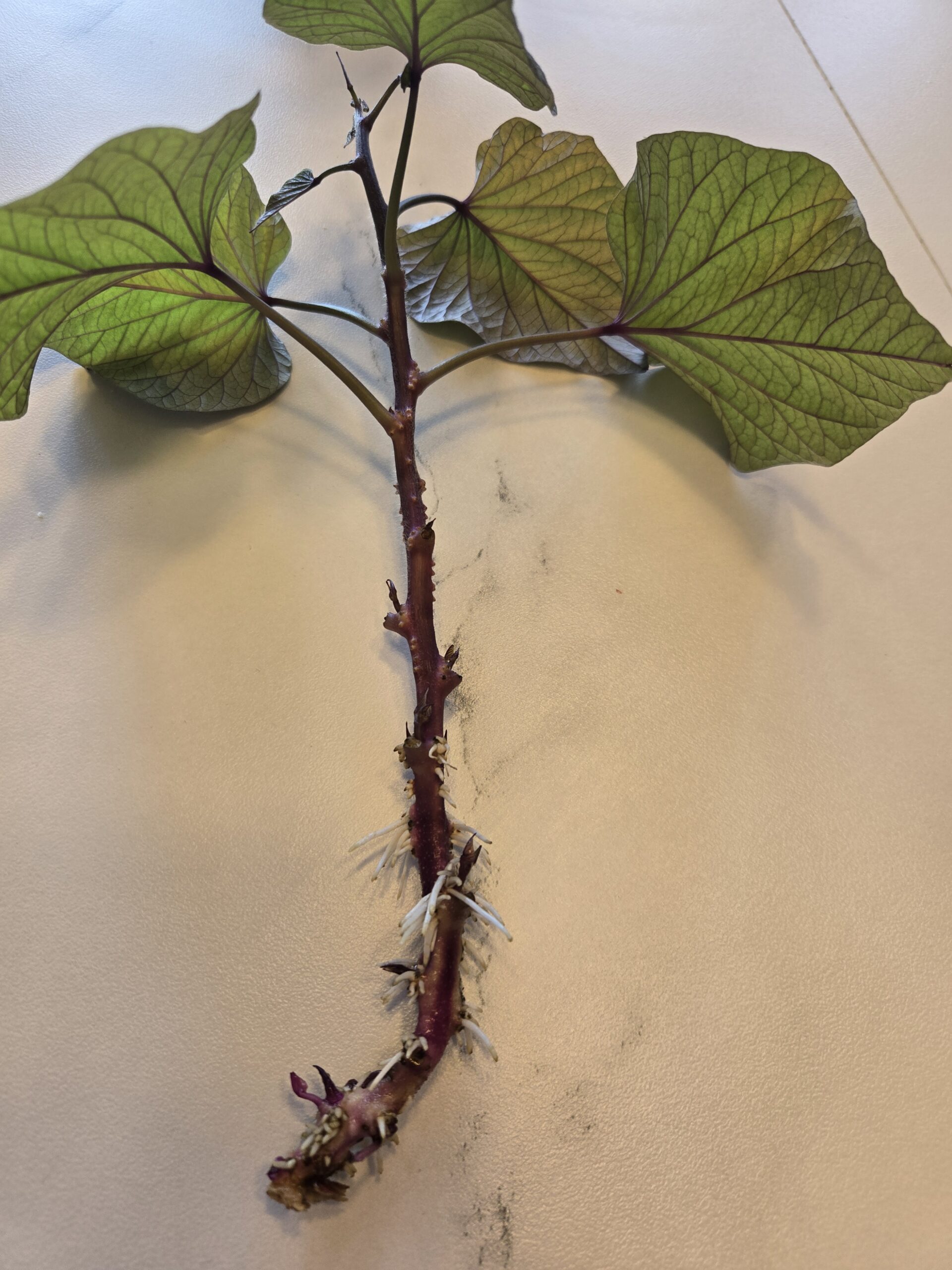
A rooted sweet potato slip starting to form strong roots before going into soil 🌱
I never set out to grow sweet potato slips by the book.
My mission was simple: grow as many as possible 😄
That was the whole goal.
Forget those tidy, postcard-perfect slips posing in a jar like seed packet models. I wanted chaos instead🌿🔥 I wanted vines to climb, leaves to pile up, and a wild tangle of slips overflowing by planting time.
Because every time I’ve tried to keep things neat in the garden… I end up wishing I had just let it run a little wilder 😅
So that’s what I did.
And if you’re here, you’re probably thinking about trying this, or maybe you already have a potato sitting in a jar and are wondering if you’ve accidentally started a science experiment 🧪🥔
Either way, you’re in the right place 👍
At the beginning, it feels like nothing is happening.
You set the sweet potato in water, maybe prop it up a little, maybe not, and then you wait… and wait just a little longer than you expected ⏳
The jar sits there, almost too quiet. Suspiciously quiet 🤨
But then something shifts.
A tiny bump appears. Then another. Suddenly, a vine stretches out, testing the air as if it’s waking up to possibility 🌱
And before you know it, that one potato starts acting like it has something to prove 💪
That’s the moment I stopped thinking, “Is this working?”
and started thinking…
👉 “How far can this actually go?” 🔥
And that question changed everything.
Because once that first vine stretched out, it didn’t stop.
It kept reaching.
Then another one joined it.
Then another.
Suddenly, the jar no longer feels like just a container. It starts to feel like a launchpad 🚀
There’s a moment when you realize you’re not just growing a plant…
You’re watching something multiply.
Not fast like weeds.
Not slow like seeds.
Something in between… something deliberate 🌿
The vines start overlapping.
Leaves stack on top of each other.
New growth shows up before you even decide what to do with the old growth.
And instead of stepping in to manage it, I stepped back.
I let it build.
Because every time I reached toward the jar, I noticed something.
Where one vine grew, two more weren’t far behind.
Where a leaf formed, a new shoot wasn’t far underneath it.
It felt less like something fragile, and more like something that wanted to expand 🌱🔥
So instead of thinking, “When should I take slips?”
I started thinking…
👉 “What happens if I wait just a little longer?”
And the answer was always the same.
More.
More vines.
More growth.
More chances.
When I finally did start pulling slips off, it didn’t feel like cutting something back.
It felt like I was harvesting pure potential ✂️🌿
Each piece I took had already lived part of its life attached to that potato.
Already stretched.
Already proven it wants to grow.
And now it was getting a chance to become something on its own.
I dropped those slips into water, starting the whole adventure over again, only this time on a smaller scale. 💧
And just like before, they adjusted.
Then they rooted.
Watching roots form teaches a whole new kind of patience.
Because this time, the growth isn’t reaching outward, it’s anchoring down 🌱
Little white roots push out, almost as if the plant is deciding, “Yeah… I’m staying.”
And once that happens, everything changes again.
Because now it’s not just a cutting.
Now it’s a plant.
That’s when I move them into soil.
Not because the calendar says so.
Not because a guide says “day 10.”
But because they look ready 👀
And when they hit soil, that’s when I finally start giving them more direct sunlight through the window ☀️
Not as a shock.
Not as a jump.
Just another step forward.
Before moving them fully outside, I ease them into it. (Hardening Off Phase)
I’ll set them outside for a little while at first, then bring them back in. Then a little longer the next day. Just letting them get used to real sun, real air, and the outside world gradually 🌤️
That transition matters more than it seems. It’s the difference between a plant that struggles… and a plant that takes off once it hits the ground 🌱🔥
If you don’t have that kind of window light, grow lights step into that role easily 💡
Nothing complicated.
Just steady light, somewhere in that 12 to 16 hour range, and they’ll keep moving forward like they were always meant to.
At some point during all of this, the question of “am I doing it right?” just disappears.
Because the plant answers it for you.
It grows 🌱
That’s it.
And once you see that, really see it, you stop trying to control every part of the process.
You start paying attention instead.
You notice when something is ready.
You notice when something wants more time.
You notice when something is about to take off.
And that’s when this stops feeling like a method, and starts to feel like a rhythm you can move with. 🔄🌿
By the time planting season gets close, I’m not counting slips.
I’m looking at options.
Which ones look strongest.
Which ones I want to give space to.
Which ones I might push just a little further.
That’s a different position to be in.
And it all started with a potato in a jar.
If you’re trying to line this up with the rest of your garden, especially timing it with when your soil actually warms up, that part can sneak up on you fast. 🗓️
That’s exactly why I built this:
👉 Planting Timeline Calculator
It helps you line everything up so your slips are ready right when it matters.
And when those rooted slips are ready for soil, and you’re wondering what to put them in, I’ve been keeping that part simple too.
Nothing fancy. Just something that drains well and lets those roots keep doing what they already started.
At the end of all this, it doesn’t really feel like you “grew sweet potato slips.”
It feels like you set something in motion and then simply stepped aside.
One potato.
One jar.
One quiet beginning.
And then…
More than you expected 🥔➡️🌱➡️🌿🔥
And if your jar starts looking a little out of control along the way?
Good 😄
That means it’s working.